
In February 2018, Google announced the arrival of AMP in emails.
AMP, for Accelerated Mobile Pages, is a technology developed by Google (but published as Open Source). The idea is to create a new format, close to HTML, with new tags enabling users to navigate in the email, fill in a form, play a quiz, etc., without ever leaving the email.
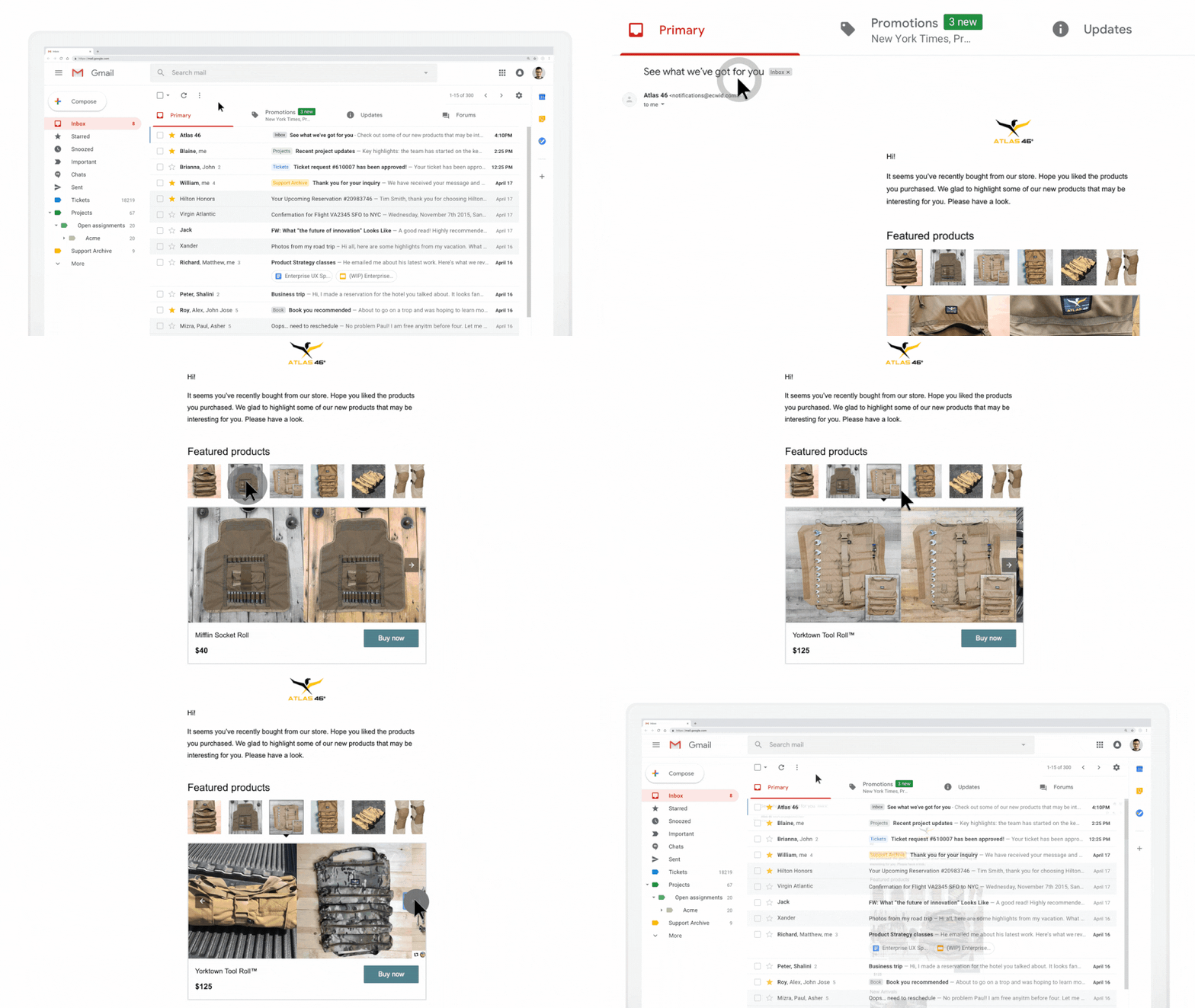
Basically, AMP makes it possible to do without Javascript (which is forbidden in e-mails... and there's no reason for this to change for obvious security reasons) what we usually do with Javascript (there's the set of described on the AMP website).
Table of contents
Gmail launches AMP to the general public
A little more than a year after the announcement in Amsterdam, Google has therefore made it known that AMP for email was now available for everyone! Well, when we say for all, it's not that simple, because in practice, you have to ask Google for approval (see here for instructions) and a whole series of criteria (which are not crazy either) must be met in order to start sending emails including an AMP version. Among these criteria, there is the obligation that the sending domain already has a minimum of regular traffic sent to Gmail servers, and especially low enough complaint rates. You will therefore need to have a good reputation with Gmail.
Another important criterion is to have an authentication SPF and DKIM valid. Moreover, as we will see in the technical part, having consistency in the use of your domain names becomes really critical. This is for security reasons and to ensure that AMP content can only come from clearly identified senders.
This article is freely available.
It took time and expertise!
This month, thanks to our customer-sponsors: Actito, Puig France, Voyageurs du Monde, CMI France, Cegeka, BPI France, Citeo, FFT, Castor & Pollux, Clarins, Mews Group. They enable us to publish free content. Thanks to them, Badsender is fulfilling its mission of educating the French emailing and CRM ecosystem to promote responsible email.
With over 10,000 monthly readers, if only 1% became customers, we'd continue this mission for a long time to come! Become a customer and benefit from our expertise while supporting the production of open knowledge.
After Gmail, it's Outlook, Yahoo and Mail.ru to embark on AMP for email!
That AMP for email is now officially deployed in Gmail doesn't really come as a surprise. But the most important announcement of 2019 is than 3 other important webmails have announced plans to implement : Outlook.com, Yahoo! and Mail.ru.
But the situation changed for Outlook (Microsoft) which, after testing AMP support, has announced that it no longer supports it.
So the three messaging services supporting AMP (Gmail, Yahoo, Mail.ru) account for around 30 % of email opens worldwide, which still limits the real impact of AMP.
Other messengers fall back on the classic HTML version.
What's in it for your emails?
Yes, because it's nice to talk about technology, technical stuff, to say that it's available now in Gmail and soon in others... but what's the point?
As you know, we have been trying to put interactivity in our emails for a long time. This is done through countdownsby modifying images according to external events (remember our advent calendar for email ?), by geolocation, quote detection, ... there are even some companies that have made it their specialty of real time in email, like Reelevant in France or LiveClicker and MovableInk.
Another trend is what is called Kinetic email, an attempt to push the possibilities ofhtml and css for email (whose possibilities are limited in some email clients) in order to bring interactivity to the messages: some email carousels, of the css animationmenus, status changes on mouse-over, tooltips, ...
The advantage of AMP compared to what we could do before? It's all built natively into the language! No more need for multiple hacks, no more need for a fallback solution for email clients that don't support certain techniques (well, in reality, we'll have to keep developing a 100% HTML version for a long time to come).
Some examples:
- Dynamically modify products or prices according to their availability at the time of the message consultation. This without having to use images, as this updated data can be contained in the text of the message (which is not the case with current techniques).
- New opportunities for multivariate testing techniques: as for the previous point, it will be relatively simple to vary the different parts of the same message according to the context and the performance generated by the previous openers.
- Create an email as if it were a mini-site/catalog: tabs, accordions, sliders, forms (with management of the sending of data and display of a confirmation message directly in the email) will make it possible to offer an interactive experience directly within the messages.
- We could go as far as imagining a chatbot in an email (we could start with a survey, but why make it simple?): Make people click, record data, confirm directly in the email, all this makes real interactions possible without having to leave the message. Ideal for example in the context of a customer service.
- ... count on us to invent (and test) uses that will enrich your customers' experience!
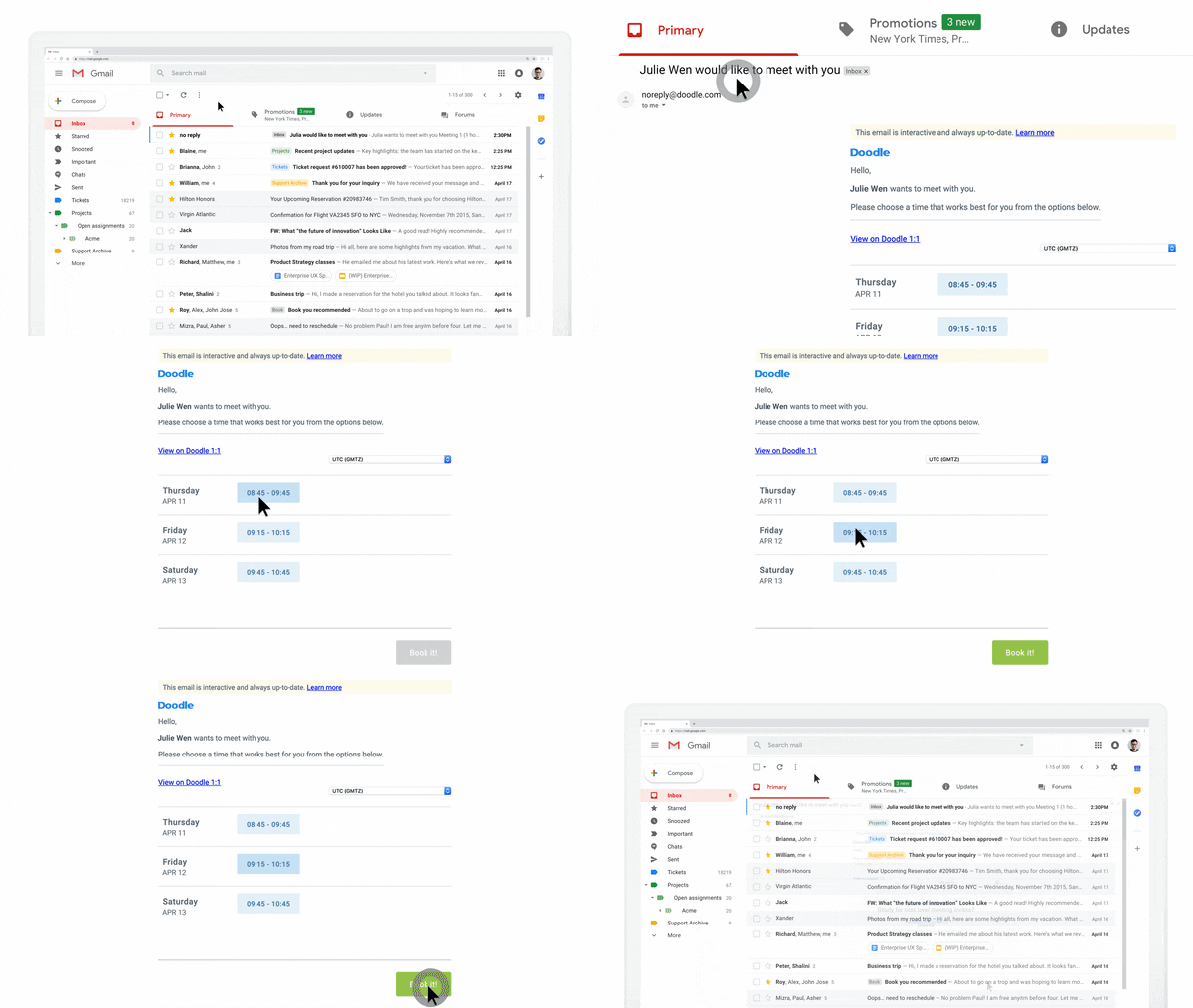
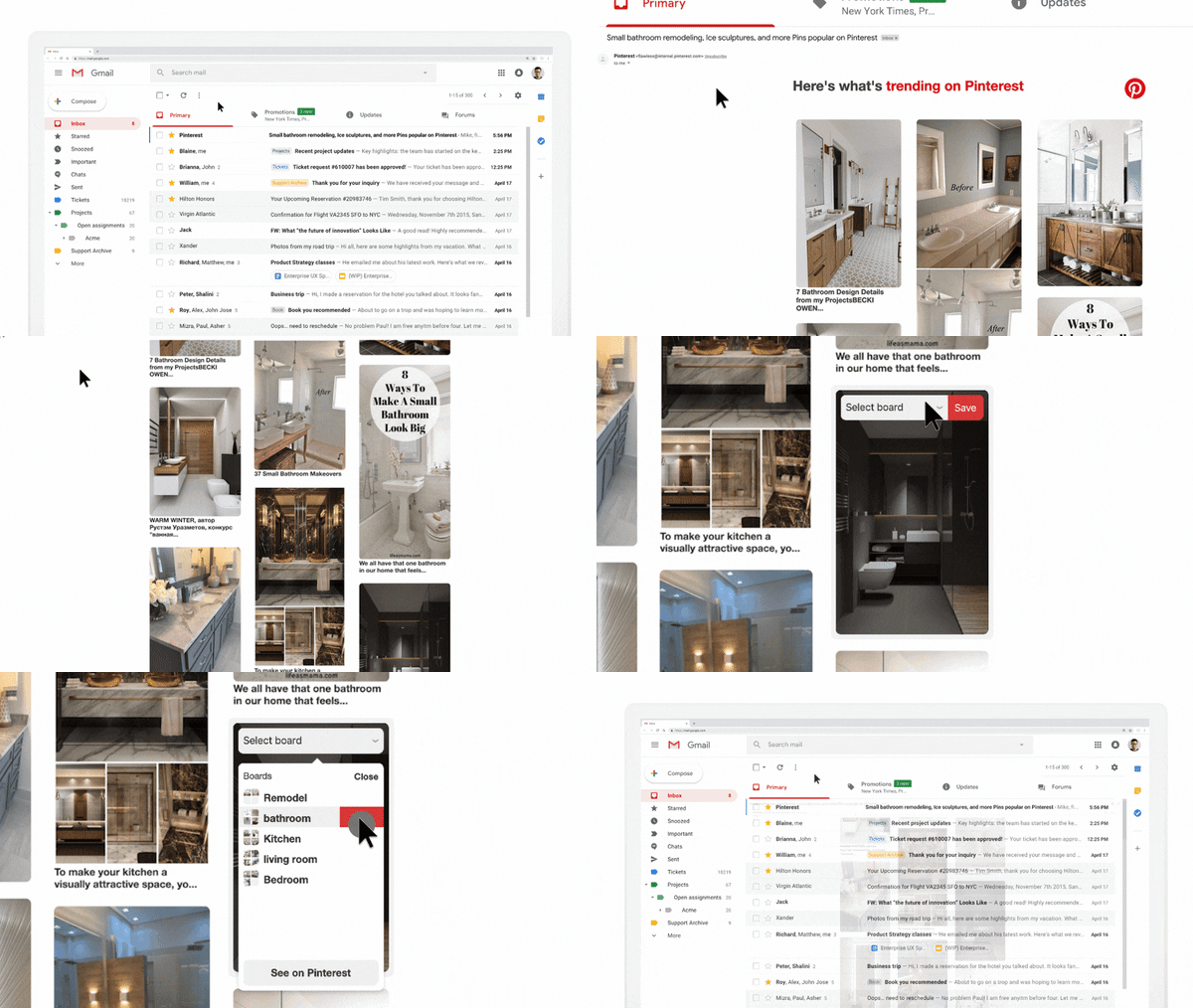
During the test phase, Google has already worked with some companies to imagine uses of AMP in email: Booking.com, Doodle, Pinterest, ...
Sample Doodle:
Pinterest Example:
In practice, there is a good chance that transactional and service emails will be the ones to see AMP usage grow. For cost reasons on the one hand (the investment is used for a long time), but also because these are the emails where the interaction possibilities will be the most valuable at first (confirmation without leaving the email, delivery status that updates itself, possibility to interact with an abandoned cart, ...).
Technical constraints: routers are not ready!
We're getting carried away, we're getting carried away, but still today in 2026, the market for email routers and other campaign management solutions is still not ready, and they're not making it a priority on their roadmap!
Indeed, technically, there are major changes to be made to their platforms, an additional format to manage in email (AMP is added to the HTML and text versions), but also email design tools to invent to make the life of email creators easier.
At first, we will probably see relatively basic implementations before more complex uses emerge. As said before, transactional and service emails will probably benefit more from AMP at first since these messages are less dependent on routing solutions.
Only a few support it, mainly American actors like SparkPost, SendGrid, Mailmodo and Amazon SES. The list is still very limited, and the majority of ESPs do not yet offer this functionality, which makes it difficult to send large-scale AMP campaigns.
France's leading routers are not making this a priority on their roadmap. Instead, they're betting on AI!
Technically how does it work?
As said above, AMP or Accelerated Mobile Pages is originally a format designed to accelerate the display of pages on mobile devices by having interactive possibilities without using Javascript. AMP for email therefore includes these possibilities of interactivity, but still limiting some of the tags.
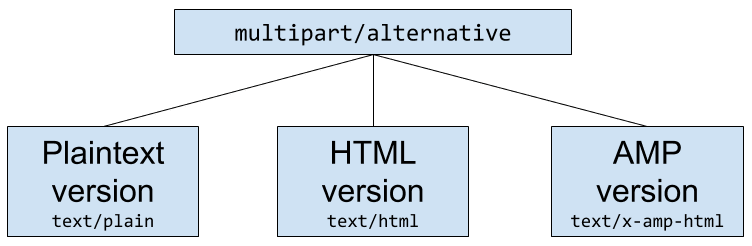
At the email level, the most important technical constraint is that you have to add an additional MIME part to your messages. The AMP tags do not have to be added to your usual HTML code, but it is a second version that must be integrated.
So, in addition to your MIME "Content-Type: text/plain;" and your MIME "Content-Type: text/html;" you will need to add a 3ème with type "Content-Type: text/x-amp-html;".
For the curious, you can play with the sandbox set up on the AMP website.
On the constraint level, we already know a little more with the Gmail implementation. For example, the remote requests (XMLHttpRequests ) must have for destination the same domain as the one used to send the emails for security reasons. This presses the nail in the coffin of the necessary consistency of the domain names used for your sender identity (the deliverability is never far away in email marketing).
A few tags that seem instrumental in the adoption of the format:
- Retrieval of external data stored in JSON for example. The potential is "huge"! Do not hesitate to go and see the doc for the tag> ;
- Changing the content/appearance by clicking on elements: changing image size, changing content, changing CSS properties. Go to the doc of the <AMP-BIND>;
- The creation of forms via the <AMP-FORM>;
- And many others like <AMP-ACCORDION> or even <AMP-CAROUSEL>
There is an introductory documentation that covers the basics of the technique for email.
Have fun!
So what does AMP mean for email in 2026?
Mailmodo's State of Email 2026 report reveals that only 24.7% of respondents sent interactive emails in 2025.
And beware, the results of this report are biased! Since Mailmodo is an email marketing campaign management platform offering an email builder using AMP technology with a predominantly American customer base. .
Among these 24.7% :
- 26.1% use AMP technology
- 34.8% are based on classic HTML/CSS
- 39.1% combine the two
There are many obstacles to adoption:
- 30.7% lack developers to code
- 19.8% fear spam
- 18.8% do not know this technology
- Not to mention budget issues
Conclusion of Badsender
Users don't open their emails expecting to interact at length with the content. They want clear, fast information, and an obvious call-to-action that leads them to your site or app for action.
Email is certainly not the right channel for interactivity in the AMP sense. It's a sweet utopia for marketers, but not for users.
Investing in MPA means :
- Making production heavier
- Multiplying development resources
- Aligning costs
- For a result visible to a minority of users
- No guarantee of any significant improvement in conversions
It's best to focus on: punchy copywriting and impeccable design.

Leave a Reply