
In each emailing and CRM audit At Badsender, we analyze the metrics and explain why they vary. We then compile a report highlighting surprising findings and providing concrete recommendations. Here, we’ve compiled the nine observations that have come up most frequently in our audits recently.
Table of contents
- Is your open rate dropping? It’s probably not what you think
- The newcomers are the ones who unsubscribe the most
- Your most engaged contacts tolerate high pressure well.
- Reactivation campaigns for inactive users: Moving away from traditional practices
- Your CRM objectives (excluding conversion) are not integrated into the email design
- One email, multiple goals: the catalog trap
- Accessibility, still the missing piece
- A single sender address for all email types
- No dashboards: it can cost a lot of money
- Conclusion: fragile strategies
Is your open rate dropping? It’s probably not what you think
Report
- A fall of email open rate, and two suspects immediately emerge: being marked as spam, or a technical issue (email size > 102kb, a tracking pixel not reporting, prefetch Gmail which distorts the measurement
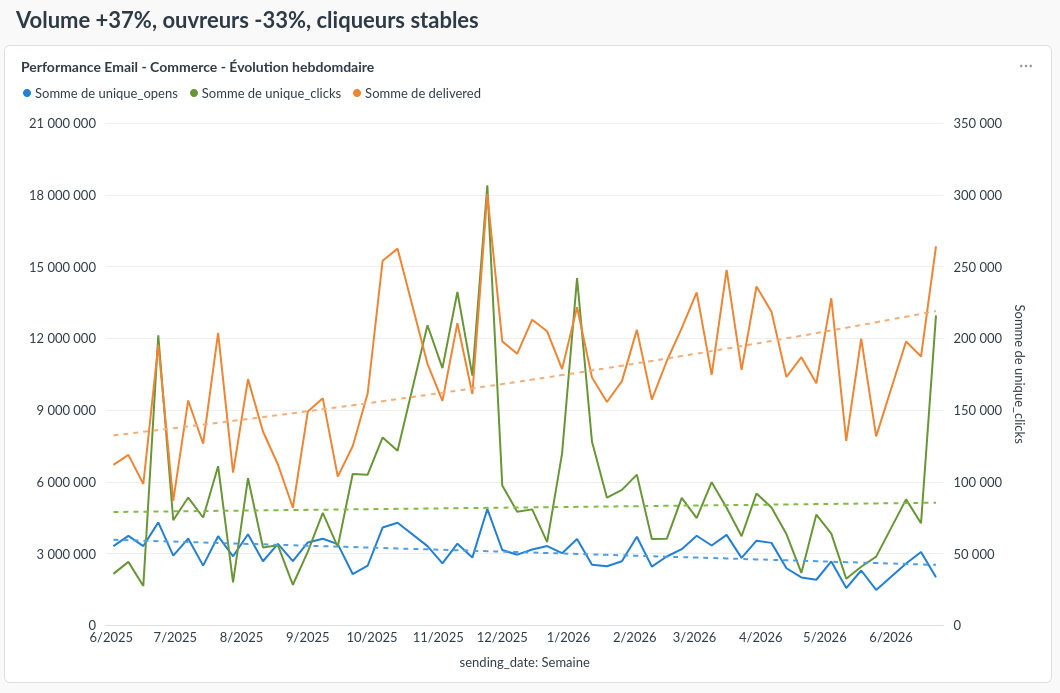
- This reflex is not absurd, but it is insufficient: in the majority of audits, the real cause lies upstream: broadened targeting and an increase in sent volumes
- The click-through rate seems stable, so we are ruling out the targeting issue (except that if it was already very low, a real degradation becomes statistically difficult to detect in the percentage)
- The absolute number of clickers isn't dropping (without really increasing either), so we keep generating sales: which creates a false sense of security and leads to the conclusion that there is a technical problem rather than a targeting problem
Reconnaissance track
- Check if the drop also affects transactional and automated emails, or only the commercial animation campaigns
- Check if it covers all your destination areas or just one or two
- Compare the % increase in volume sent with the % change in openers and clickers if volume grows faster than them, your base has been diluted
- Reconstruct the timeline broadened targeting a few months ago, an increase from one to two newsletters per week, and the picture becomes clearer
The newcomers are the ones who unsubscribe the most
Report
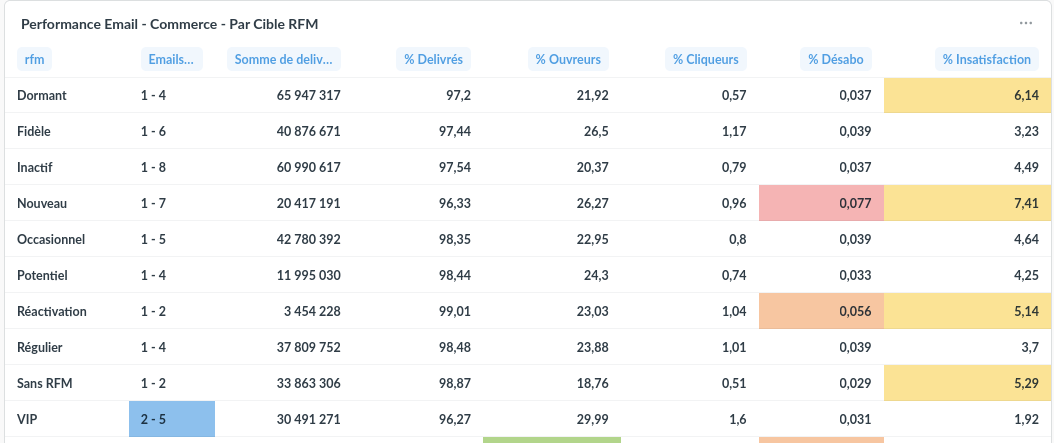
- It is often the segment with the email churn rate the highest in the entire database, a counter-intuitive result given that long-standing subscribers, considered «fatigued,» are usually suspected first»
- When you dig deeper, you notice that the welcome pack is reduced to a single email
- Yet newcomers need to be pampered, to get to know you, to trust you before making a first or second purchase. And that takes time; it doesn't happen in just a single email.
Reconnaissance track
- Extend the welcome tour in several steps before integrating the new contacts into standard targeting
- Gradually increase the sending frequency start slowly, observe if it is well tolerated (by measuring the dissatisfaction rate), before increasing
Your most engaged contacts tolerate high pressure well.
Report
- When observing the sending frequency on the most engaged segments, one is often surprised to find it enormous
- And yet, that's not a problem: open and click-through rates remain good, the unsubscribe rate remains low
- This is the audience least sensitive to frequency, the one that requires no urgent corrective action
Reconnaissance track
- Adjust the sending frequency based on engagement of your contacts rather than applying a uniform frequency to the entire database
- What you save in pressure on the least committed, invest it in those who tolerate it
Reactivation campaigns for inactive users: Moving away from traditional practices
Report
- Since’AMPP (Apple Mail Privacy Protection), and more recently with the consent required for open pixels, the reactivation strategy is upended
- Relying solely on open rates to define an inactive user is becoming risky, even more if your openings are fluctuating (see first finding)
- The classic reflex consists of sending commercial engagement campaigns to active users, pushing inactives aside, and then sending them a reactivation campaign (often a nice promo) in an all-or-nothing mode: if they open, they move back up into the active segment, otherwise they are switched to opt-out.
Reconnaissance track
- Integrate the click, not just the open, in your definition of an inactive contact (and go further if you have other reliable indicators at your disposal)
- Segment your inactives rather than treating them as a single segment: the very old inactives (more than 18 months of inactivity) can be excluded from mailings, while more recent inactives (less than 18 months of inactivity) deserve reduced pressure, one email per month for example
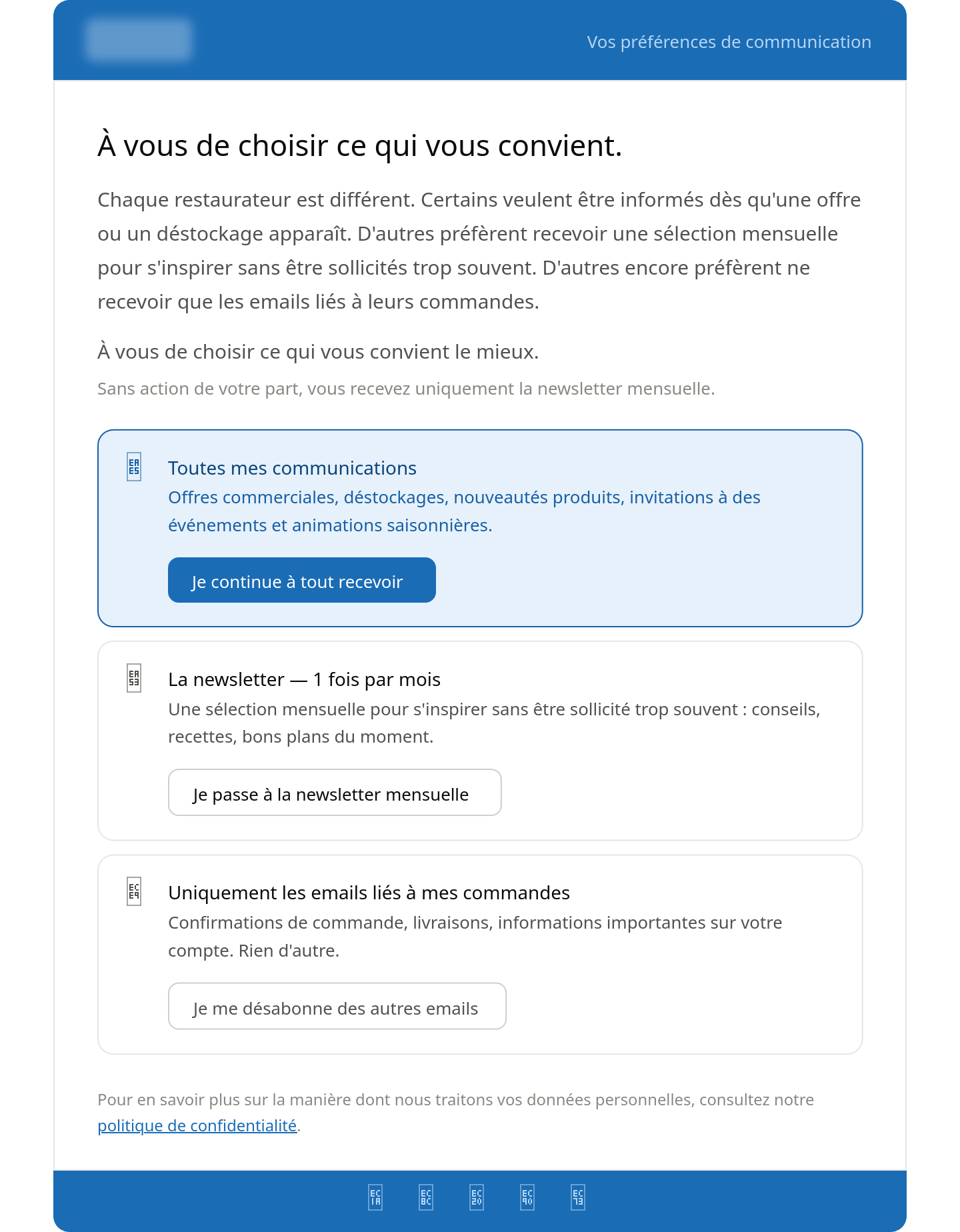
- Rather than a classic re-engagement campaign in promo mode, Ask them to choose what suits them best in terms of the frequency of contact : continue receiving everything, receive one newsletter per month, or unsubscribe from everything. And if the contact is a customer, specify that they will in any case continue to receive emails related to their orders.
- For drafting this email, draw inspiration from the recommendations of marketing PhD candidate Tom Villenet to reinforce the perception of honesty in your approach.
Your CRM objectives (excluding conversion) are not integrated into the email design
Report
- The campaign teams all have in mind the commercial conversion objective they need to generate
- But when they are asked about the other CRM objectives in their strategy, there is a blank. For example: increasing the number of members in a loyalty program, diversifying into repair, rental, or extended warranty services. These fundamental objectives are less widely shared and less frequently discussed internally.
- The result: once or twice a year, we send out an email dedicated to this service offering—but that’s it. Yet this offering is meant to continuously support product sales. Customers buy a product, and the associated service (repair, for example) should be constantly top of mind for them—not just on the day we send them a dedicated email.
- It is by integrating these content blocks continuously, directly into the promotional emails themselves, that one truly supports a revenue diversification strategy. If it is not visible, it cannot perform.
Reconnaissance track
- Systematically integrate, from the design stage, blocks dedicated to these secondary CRM objectives
- Do not reserve these objectives only for campaigns explicitly dedicated to them: make them a common thread present in your ongoing campaigns
One email, multiple goals: the catalog trap
Report
- The emails are long and often combine multiple objectives at the same level of importance a list of products or services, multiple messages, multiple CTAs, without clear hierarchy
- Result: the reader doesn't know where to click. He must choose for himself what matters to him in this catalog of suggestions, and in practice, he does not do it: he has neither the time nor the desire to prioritize on behalf of the sender.
- Yet, the best practice in email remains simple: one email, one objective. However, the current reflex is often the opposite: everything is piled into a single email, and then we simply follow up on it as is once or twice.
- The results are bad, but that is not surprising: if the email is not clear, if no product or service is highlighted more than another, the reader will close it without retaining anything
Reconnaissance track
- Break down your journeys into several sequenced emails, each carrying a single clear objective (secondary objectives may coexist, but only one must remain visually dominant)
- In your templates, make one block stand out more than the others to draw the eye—and thus the click—to what you want to highlight
- Reconstruct the follow-up not as a repetition of the same email, but as an additional step in the journey, with its own specific objective
Accessibility, still the missing piece
Report
- Lack of a structure suited to email and webmail environments, absence of a «presentation» role in layout tables, lack of semantic tags in text content, non-explicit links, and improper use of alt attributes: these are often the first elements found to be missing when auditing the’email accessibility
- However, Digital accessibility (including email) has been mandatory for all private companies since June 2025. (European Accessibility Act)
- The real problem is the lack of awareness, and above all, the failure to prioritize this subject by CRM management teams. the fine is probably still too low to reverse the trend. The teams that design emails do not always understand what accessibility actually entails, nor why it matters
Reconnaissance track
- Train teams on the fundamentals of email accessibility (even if they use an email builder)
- Prioritize the subject emails must be readable by everyone, starting with transactional emails
- Integrate accessibility right from the design of your templates
- Set up regular check-ins
A single sender address for all email types
Report
- Newsletters, commercial campaigns, transactional and lifecycle emails: it all starts from the same shipping address
- However, a sending address carries a reputation
- While mass campaigns, sent widely and sometimes to unengaged contacts, degrade this reputation, it is also critical emails (order confirmations, password resets, welcomes) that suffer as a result.
Reconnaissance track
- At a minimum, separate your sending routes between promotional campaigns and transactional emails
- Dedicate a different subdomain to protect emails the most critical of a reputation incident that does not concern them
No dashboards: it can cost a lot of money
Report
- Real CRM dashboards for marketing campaigns are rareAnd when they do exist, they were developed in a BI tool by the data team: they are not always designed to easily track results, nor are they adapted to the reality of the email marketing strategy (by typology, by targeting, etc.)
- Dashboards to monitor deliverability are missing. : metrics tracked by domain and by week. This type of table makes it possible to spot an issue in a specific domain, identify the exact day of the drop-off, and investigate down to the campaign and targeting causing the malfunction.
- Google Postmaster Tools, which makes it possible to measure the volume of complaints generated among Gmail users, is rarely implemented. While it allows for anticipating potential future deliverability problems.
- Automated campaigns are not monitored week after week, just to verify that the scenario campaigns are still going out and to check that the indicators are stable.
- Result: the day an incident occurs, no one sees it, nor knows how to defuse it quickly. Without dashboards, you don't have a robust emailing strategy.
Reconnaissance track
- Have the CRM teams lead the dashboard briefing themselves with the data teams, rather than the other way around
- Implement continuous monitoring across three pillars deliverability, commercial campaigns, automated campaigns
- Integrate the dissatisfaction rate to your usual monitoring indicators
Conclusion: fragile strategies
Taken separately, these 10 findings look like disparate technical points. Placed side by side, they tell another story: that of an emailing strategy that only holds together if nothing changes.
CRM teams are expected to perform: more volume, higher frequency, more conversion, right away. But an extremely optimized strategy for immediate performance almost mechanically becomes a fragile strategy.
Targeting that expands without measuring the impact. Frequency that increases overnight for the entire database. A single sending address that exposes the entire system to the slightest incident. Gmail changing the way it measures metrics. A deliverability criterion being added or tightened. A data feed that stops responding. And the list goes on!
Without governance, these fluctuations hit you full force: your strategy does not hold up.
CRM governance is about creating a framework where you can afford to experiment expand targeting, test a new frequency, without jeopardizing the entire strategy. Without this framework, every decision becomes an isolated gamble. With it, every decision becomes a controlled experiment.
That is precisely what our audits aim to build not just optimizing your current rates, but consolidating the foundations that will allow your email strategy to withstand whatever unexpected challenges lie ahead.

Leave a Reply