
Last week, we received a LinkedIn message from Tom Villenet, a doctoral candidate in marketing, in the field of CRM at iaelyon School of Management (University of Lyon 3). He shared his explanatory note with us on a topic that concerns us directly at the moment: the communication angle to adopt for The tracking pixel information email (to be sent before July 14, 2026, to all your existing bases).
We found this note really interesting and wanted to share it here with all of you who are preparing this email. Because the way we say things can influence the volume of pixel withdrawals and unsubscribes. And the lessons that follow go far beyond this single email. They are just as useful for the email collecting pixel consent, for preference update emails, or for any email where you are asking something of your contacts.
Access Tom Villenet's tracking pixel briefing memo (PDF)
Tips for writing a good email
The first part of the note is a bibliographic synthesis of the academic literature on consent, privacy, and personalization. This part is super interesting because there are psychological mechanisms well-documented.
Here are the key points.
A balance between perceived benefits and costs
Each recipient will consciously or unconsciously weigh the pros and cons of this email.
- Perceived benefits Receive more tailored communications, more.
- Perceived costs feeling of being monitored, fear of data being resold, risk of this information being used against him (price discrimination, for example).
This calculation is subjective. It varies from person to person. This is what makes the exercise difficult and what justifies paying as much attention to the substance as to the form.
Not all your contacts will react the same way.
The research identifies several profiles:
- The Indifferent : They agree without giving it a second thought.
- The Pragmatists they consent if the benefit seems clear and proportionate to them.
- The Protectors They will refuse no matter what, even with the best guarantees. These people are not to be convinced. The goal is simply not to alienate them further. Knowing that these profiles exist is already be prepared to accept a certain opt-out rate without panicking.
Personalizing your email can backfire
Research says that well-balanced personalization with clearly provided customer data and a high level of relevance strengthens the relationship.
Meanwhile, «half-hearted» personalization is perceived as intrusive and uncomfortable, without providing any real value.
So, revealing in the CNIL email that we were using data collected without the customer’s full awareness could create mistrust where none existed before.
Personalization should be handled with care. For your clients, don't hesitate to include in the header a reminder of the contract they subscribed to, or elements that show there is already a close relationship. But personalizing by saying «We sent you N campaigns in 2026, you opened Y» without explaining how this information benefits the contact is counterproductive personalization. It uses data for the sake of using data. And it highlights the commercial pressure they are under: N campaigns in a few months can be chilling. One more reason to click on «I manage my preferences» or worse, on «Unsubscribe.».
An informative 100% strategy is the least effective
The research identifies three possible approaches for this type of email:
- For informational purposes only This communication details how personal data is collected and processed, and the actions users can take. This is the «compliance only» strategy. Research on GDPR consent requests shows that this informational strategy is the least effective.
- Purely persuasive This communication highlights the desirability of data exchange.
- Either by offering rewards: discounts, exclusive access.
- Either by presenting sharing as a way to gain benefits.
- So, playing on the fear of missing out if you refuse.
This strategy is not consistent with the CNIL recommendation, which requires clear and unbiased information.
- Coed: This communication combines both approaches. It explains what information is collected, why, and how, and also clearly outlines the benefits for the recipient (more relevant emails, fewer spam messages, and a more personalized experience).
This is the strategy recommended by the memo: Be transparent and informative, while clearly explaining the specific benefits for the recipient.
The choice of words in the CTA button is not insignificant
A study shows that it is preferable to use terms based on recognition or awareness.
Conversely, permission-based vocabulary makes privacy risk more salient in the recipient's mind, reducing their willingness to consent.
For opt-in emails: rather than ’Accept,» »Allow,« or »I consent,« favor phrasing like »I am informed,« »I understand,« »I take note,« or »Noted.«.
For the tracking pixel information email, instead of «I object to the tracking pixel,» «I withdraw my consent,» «I refuse,», Prioritize «I express my choice» «I manage my preferences».
The psychological nuance is important: the client doesn't feel like they're giving something up, they're simply acknowledging information.
Two important nuances that the note specifies:
- This effect is more pronounced in low-perceived-risk everyday sectors, such as retail or entertainment.
- In the banking, insurance, or healthcare sectors, there is no significant difference between the two types of wording.
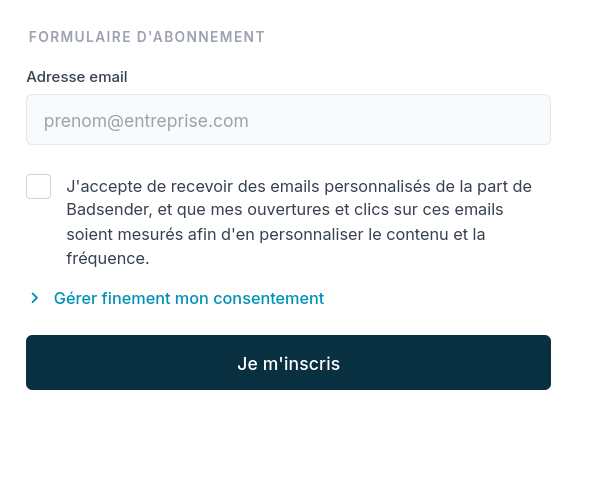
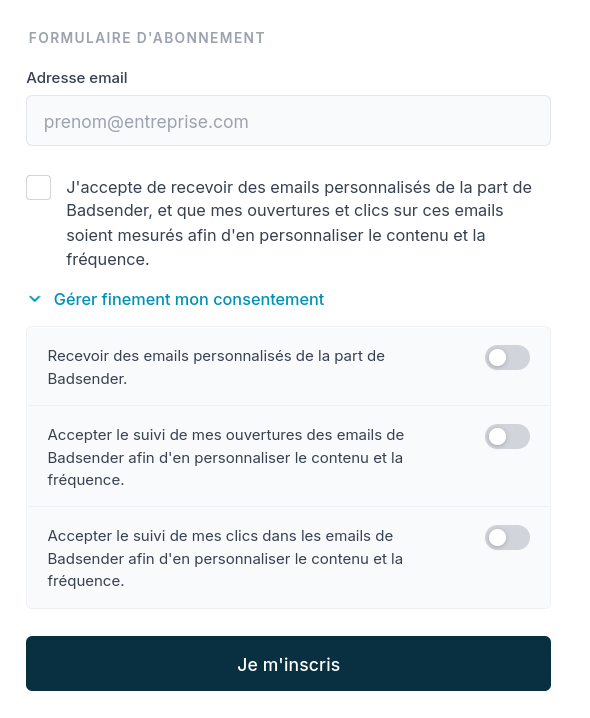
Collection Form Double consent can create friction: the order of requests matters
Tom's memo explains that obtaining two consents can create an additional point of friction in the customer journey and can therefore increase drop-off rates.
Research explains that accepting one request can increase the likelihood of accepting a subsequent request.
This reinforces our confidence at Badsender in the proposal we have made to several of our clients:
A/B testing for newsletter emails and data collection forms?
The explanatory note also proposes two field experiments:
- an A/B test on the newsletter (three variations based on the type of personalization used)
- and a test on the contact collection form design.
An A/B test doesn't seem very realistic to us. What's keeping the teams busy right now is finalizing compliance, aligning the legal, marketing, and CRM teams, and getting ready to send out the informational email around July 7–8.
Setting up an A/B test within this timeline seems unrealistic to us.
And it's important to remain vigilant: the A/B test should not affect the substance of the information: existence of the pixel, data collected, purposes, possibility of opting out, unsubscribe link. It should only focus on how to illustrate the benefits for the client. Mandatory content must remain intact and in full compliance with the CNIL recommendation.
A/B testing remains a worthwhile approach as we head into the fall or through the end of the year. This is particularly true for data collection forms and consent withdrawal pages.
In conclusion: trust as a central mechanism
This is the common thread throughout the entire synthesis. Handled well, this type of email can reinforce the company's perception of honesty and benevolence. Handled poorly, it reveals previously invisible tracking and can generate distrust.
What is valuable about Tom Villenet’s work is that his literature review goes far beyond the case of tracking pixels. The insights on cost-benefit analysis, consent profiles, the effectiveness of the information-plus-persuasion mix, and word choice in CTAs are directly applicable to other types of emails: preference update emails, opt-in collection emails, re-engagement campaigns, progressive data collection…
A big THANK YOU Tom for this work.

Leave a Reply