
For years, when we talk about LePatron, we're talking about a email builder. Industrialization, design system, brand consistency... That's what made its reputation, and that's not changing.
What's changing is what's around it. Today, LePatron is welcoming a new module: CRM Intelligence.
It allows you to build Custom dashboards for tracking the performance of your campaigns and contact database, directly in LePatron, next to the Email Builder. Campaign performance, engagement, deliverability, Base Health: Manage your CRM activity all in one place.
This is also LePatron's first module to move beyond the strict scope of email creation, and it will herald others. This is because we've held a conviction for some time: CRM and marketing teams need to manage, document, frame, and measure. LePatron aims to support them in all these areas, not to replace their ESP, but to become the business layer that lives above it.
CRM Intelligence is the first visible brick of this shift.
What is it, concretely?
CRM Intelligence is Custom performance tracking dashboards, directly in LePatron. You can access it from the interface, right next to the Email Builder.
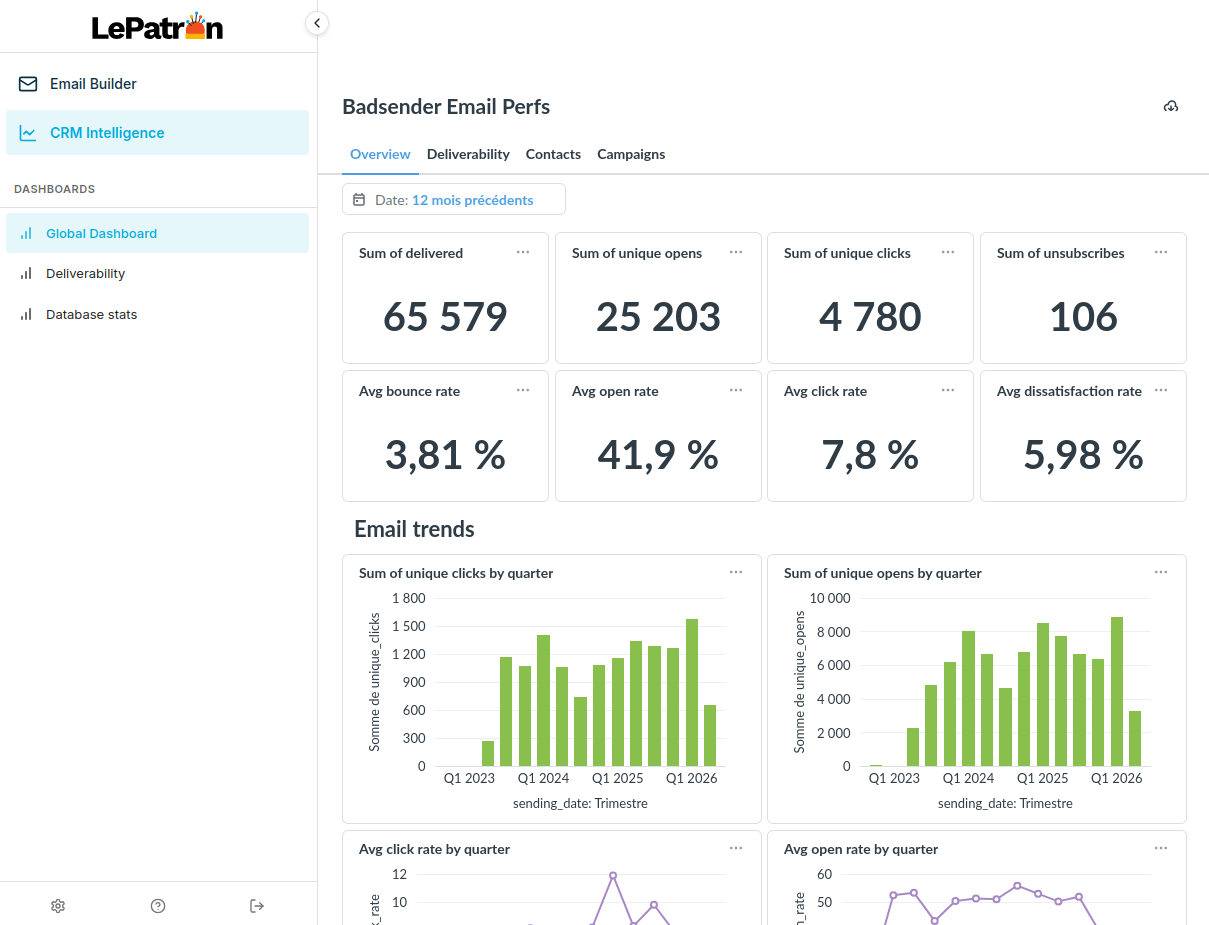
Tracking campaign performance, engagement, deliverability, contact database health, population analysis... These are all topics that, today, are too often scattered between the routing tool, a few Excel files, and, when it exists, a BI tool that no one really opens because it wasn't designed for email marketing.
The idea behind CRM Intelligence is to consolidate this management in a single place, and above all, to make it understandable and actionable for CRM teams, not data analysts.
An open and sovereign solution
Technically, CRM Intelligence relies on Metabase, in its open-source version, hosted by Clever Cloud, in France (like LePatron himself).
This choice isn't an implementation detail, it's a stance. No per-user licenses, no dependence on extra-European infrastructure, no vendor lock-in. Your data stays with you, within a compliant framework, and the infrastructure can even be re-internalized upon request. We build with open bricks because we refuse to trap our clients, and because sovereignty and compliance are, for us, integral parts of data governance, just like everything else.
This is also consistent with what we are: a sober, open-source, maintainable technical stack, without any gimmicks.
Our DNA is bespoke.
CRM Intelligence is not a generic dashboard you activate with a single click. We could have delivered a single template, the same for everyone. That's not our business and it's not what serves our clients. Each CRM context is different: brands, segmentations, opt-ins, acquisition channels, campaign typologies, deliverability stakes. A useful dashboard is a dashboard that speaks. of your activity.
And above all, what makes the difference isn't knowing how to use a BI tool. It's knowing how to What data to show, and in what format. That's where all the value lies.
We are not a BI agency. We are CRM and email marketing experts and deliverability, and it’s this cumulative experience across dozens of projects that tells us which indicators truly matter, which are red herrings, and how to make them legible so they trigger decisions. We don’t do data visualization. We do email marketing piloting.
Two project types: performance and base evolution
Not all CRM Intelligence projects are the same. There are two main families of dashboards, which are not based on the same data and do not represent the same level of ambition.
- Drive campaign results and performance. This is the most natural starting point. Based on your sending data, we build dashboards that track campaign-by-campaign performance, evolution over time, reading by destination domain, deliverability health, and the pressure exerted on your contacts. This level answers the question, «Are my campaigns working, and why?» Most projects start here, and for many, it's already more than sufficient.
- Understand and track the evolution of the database. We are changing dimensions here. It is no longer about measuring campaigns, but about understanding a contact population over time: cohorts, lifecycle, base growth and churn, inactive users, unsubscribe behavior, and reactivation potential. This level requires more advanced data modeling and a real rigor regarding privacy: we are working with data anonymized and aggregated, Never on named individuals. It's more demanding, but that's also where the most strategic analyses are found.
The right level for a given client depends first on what their data allows, and that's precisely what we look at first.
How does a CRM Intelligence project proceed?
To help you visualize, here's what a deployment looks like. Nothing magical, just a well-defined project.
The framing. This is the most important step, and it's already an act of CRM governance. We audit the data actually available in your tool, establish a feasibility matrix (what's available, what needs to be created, what's impossible as is), and most importantly, we decide together which indicators are worth tracking. To decide what Measurement is an expertise in itself.
2. The implementation of the infrastructure. We provision the dedicated environment, connect the data sources, structure and validate them.
3. Dashboard construction. Iteratively and prioritized. We quickly deliver a useful foundation rather than waiting for the grand unveiling, then we enrich it. This is where business expertise makes the difference: which visualization for which KPI, what level of granularity, what filters to make it truly actionable.
4. The recipe and training. We validate the consistency of the figures, we ensure that the teams are autonomous.
5. Deployment and support. Going into production, then ongoing monitoring. A CRM Intelligence project is not static: needs evolve, as do dashboards (like a design system).
A first step before the next
CRM Intelligence marks a milestone: LePatron is opening up to uses beyond email creation. It is the first module of a platform designed to support CRM teams in their entire governance: their charters, their design system, their quality control, their deliverability documentation, and their compliance. Other modules will follow.
One thing will not change: LePatron is not looking to replace your ESP, your CRM, or your CDP. We integrate with your existing systems, becoming the control and governance layer above, not another tool that claims to do everything.
If you'd like to see how CRM Intelligence could help address your specific challenges, talk to your Badsender representative, or write to us.

Leave a Reply