
Updated on January 26, 2026 - This article was originally published in March 2021 to share our migration process. from our emailing agency towards more environmentally-friendly hosting providers. Since then, the context has changed: the question of European digital sovereignty has become a major issue. Between the American Cloud Act, geopolitical tensions and growing dependence on GAFAM, we felt it essential to complete our analysis with this now inescapable criterion.
What's clear from this update is that our initial choice to move towards opensource solutions was not just an ethical commitment: it's also a strategy that offers us real freedom. By choosing open-source tools, we can decide where to host our data. With environmentally committed players such as Infomaniak or Clever Cloud, but also with European hosts who guarantee that our data remains under European jurisdiction. Opensource is the key to both digital ecology and sovereignty.
A trajectory, not a destination
Let's be clear: we're not perfect, and this painting is proof of that. Our approach is a humble one. It's not about brandishing a «100% sovereign and ecological» label - that would be a lie - but rather about defining a trajectory that informs our day-to-day choices and our future decisions.
The most obvious example is Notion. Our knowledge base, our project management, our internal processes: everything runs through this tool. And yet, Notion ticks virtually none of our boxes. Hosted on AWS in the USA, proprietary, with no documented environmental commitment. Do we plan to do without it? Honestly, not at the moment. The dependency is too strong, and no alternative today offers us the same level of functionality and adoption by the team.
And above all, it would be a huge job for our small team to manage this migration.
But we are aware of this contradiction, and it is precisely this awareness that must guide our future choices: when a credible alternative emerges, we'll be ready to take the plunge.
Opensource: facilitating ecological choices AND digital sovereignty
Initially, we looked for equivalents to our tools that would provide us with guarantees, first ecological, then sovereign. And then, good luck. Because there isn't much to choose from. SaaS solutions that tick all the boxes (European hosting, documented environmental commitments, open code) are rare, if not non-existent.
So we turned the problem on its head. What if we hosted the various building blocks of our information system ourselves? Then we'd just have to find a hosting provider that was both environmentally friendly and European. This questioning structured our approach around two axes:
- Use free and opensource solutions whenever possible. Because these solutions can be installed anywhere. So it's up to us to place them on servers that meet our criteria, be they eco-friendly or sovereign. A proprietary tool hosted in the U.S. leaves you with no choice: you're subject to the publisher's infrastructure, data policy and jurisdiction. With opensource, you regain control. And then, fundamentally, it's a logic of value creation that corresponds well to what we've been doing since the beginning of Badsender: creating content and sharing it, creating methodologies and sharing them. Our white papers have been licensed under Creative Commons for some time now, and TheBoss.email has been opensource since its creation.
- Host these solutions with committed European players. For our collaborative tools and websites, we have chosen Infomaniak, a Swiss hosting company whose ecological approach is documented, certified, and supported by renowned actors. For the’email builder LePatron.email, we have opted for Clever Cloud, a French PaaS hosted in France. In both cases, these are independent companies, owned by their founders or employees, with datacenters located in Europe, beyond the reach of the American CLOUD Act. And these are criteria that count as much as environmental commitments.
The dashboard of our digital sovereignty
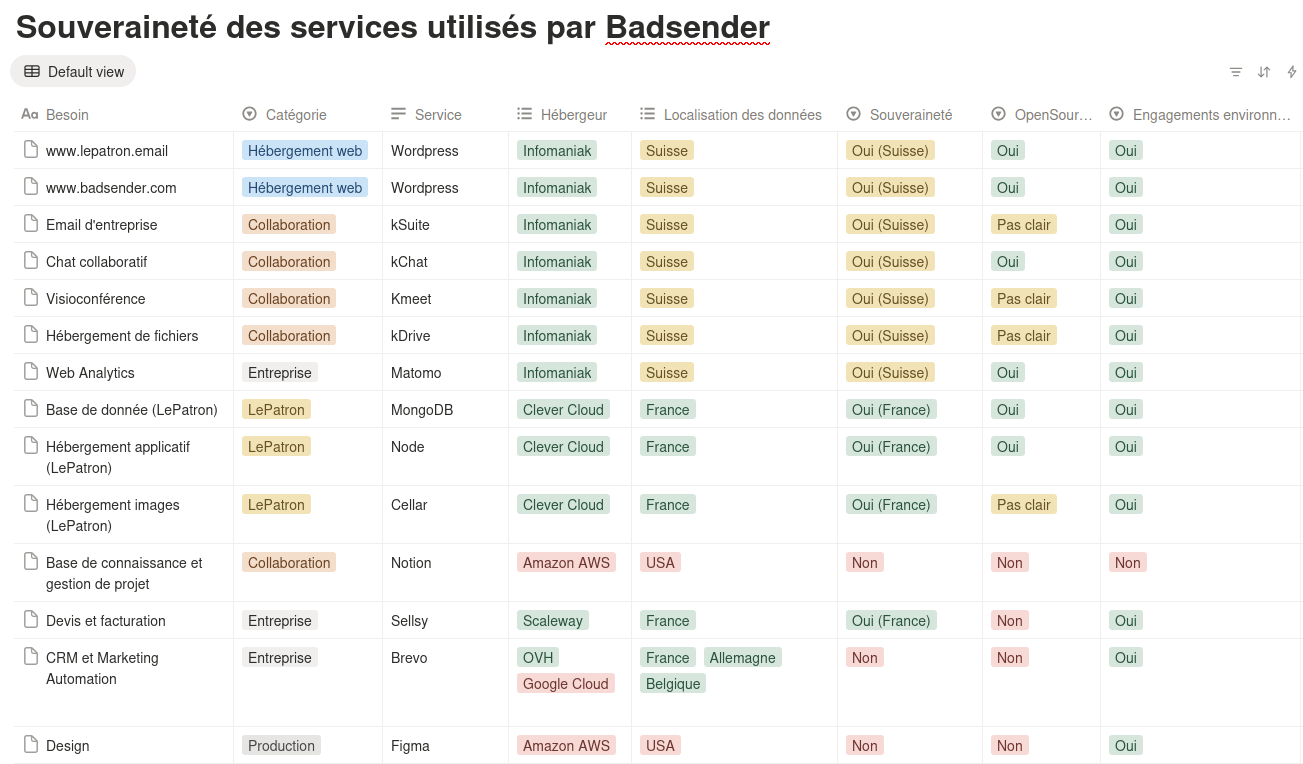
We have compiled all our tools in a table that cross-references several criteria:
- Data localization Where is our information physically stored?
- Sovereignty Is the company European, owned by Europeans? This is a crucial criterion, as even data hosted in Europe may be subject to the Cloud Act if the publisher is American.
- The opensource character Do we have the freedom to migrate to another host if necessary?
- Environmental commitments Has the publisher or host documented its ecological approach?
Here it is, unfiltered.
Why go public?
The aim of this transparency is twofold.
First, for ourselves. This chart is our compass. It enables us to visualize where we are, to identify our weak points, and above all to inform our future decisions. When a new tool comes along, we'll have this benchmark in front of us: are we going forwards or backwards? It's not a fixed audit, it's a steering tool.
Secondly, to take part in a broader movement. We are convinced that European digital sovereignty cannot be decreed; it must be built, company by company, choice by choice. In publishing this table, we want to show that it is possible. That a twelve-person agency can run most of its business on European tools, published by independent companies that are not subject to extra-European jurisdictions. This is neither a sacrifice nor a constraint: it's a strategic choice that works every day.
Our hope is that other companies will do the same. That this type of chart becomes a standard, a reflex. Let the question «who really controls this tool?» become as natural as «how much does it cost?». In the meantime, we're sharing our copy, and inviting everyone to do the same.

Leave a Reply