
In email marketing, you only have a few seconds to grab the reader's attention. Without an immediate, captivating «hook», your email is likely to go unnoticed.
So how do write an email or newsletter which really grab readers' attention ? How to find the right angle of attack?
Writing an e-mail is not something to be taken lightly. By asking yourself the right questions, you can easily identify the right angle of approach and the key messages to get across.
Here's a 7-step writing process that you can apply today.
Table of contents
- Step 1. Write down your campaign objectives in black and white
- Step 2. Who are you targeting?
- Step 3. List the essential and relevant messages to be communicated
- Step 4. Don't forget to reassure: the importance of social proof and alignment with values
- Step 4. Respecting local laws: contextualizing
- Step 5. Write with your key message in the subject line
- Step 6. Prioritize your messages with visual cues in your email
- Step 7. Read your email as if you were one of your readers
- Putting it into practice: examples of before-and-after email copywriting
- Basic good writing practices
- Checklist of best practices in emailing copywriting
- Conclusion
Live! How to write a powerful email? What's the best writing process?
In this live interview, Marion Duchatelet and Jonathan Loriaux explain their copywriting process to us, so we can find the right angle of attack to create impactful emails. With before and after examples.
The link to the live site is : https://www.youtube.com/watch?v=eJnZsQ_ZVhU
Step 1. Write down your campaign objectives in black and white
It sounds silly, but it's essential.
During our coaching sessions on email copywriting, when I ask our customers what the purpose of their email is, I often get an answer of «well... to sell».
And yet, with a little digging, you can define a precise main objective and clear sub-objectives.
For example, in the insurance sector, behind the objective «boost contract sales to meet 2025 targets», we find :
- main objective Inform us of a payment deadline
- sub-objectives :
- encourage autonomous online payments
- invite you to make an appointment with an advisor by telephone if you need assistance
Knowing all this helps to structure your email: you know what to put in the subject line, in the main block, in the main CTA and in the secondary CTA.
Step 2. Who are you targeting?
It sounds simplistic too, but it's also important to keep in mind who you're targeting.
Ask yourself these questions:
- Who are you targeting?
- How well does this target group know you?
- Who is she used to interacting with within your brand?
- What data do you have on this target?
- What data would be useful to personalize the email?
Step 3. List the essential and relevant messages to be communicated
When analyzing email content in our audits, we often find that the main message, or editorial angle, is not clearly defined or sufficiently emphasized.
For example, if you need to promote a new inventory management platform, focus on what it actually changes for users: optimizing stock levels, reducing order errors, saving on storage costs? The core of your message should highlight one of these concrete benefits, rather than simply announcing a «new inventory management platform», a formulation that lacks relevance.
By choosing a relevant angle of approach, you'll enable the reader to feel immediately concerned.
Before you dive headlong into writing your email, identify on a piece of paper the key messages you need to convey to your audience. Ask yourself the following questions:
- If your target audience had to remember just one message from your email, what would it be?
- What action do you expect your target to take after reading the email? (to be clear about the CTA (call-to-action) button(s) in your email).
- Can you describe exactly what they need to do? What are the concrete steps involved (e.g. fill out a form on a landing page, call the...)?
- Is there anything they need to know before acting? Is there a sticking point in the process that should be pointed out upstream (e.g. knowing your customer number, getting past a particular stage in the process, etc.)?
- What concrete benefits do they derive from their action? How will it help/relieve/enjoy/enable them in their lives?
- Why send the email now? Why on this date?
- What makes your product or service better or different from the competition?
Answering these questions will give you your list of messages to send. Then rank them in order of importance from the main message to more secondary messages.
Finding hard-hitting answers to these questions is no trivial matter.
For this, it's essential to know your audience (their concerns, challenges, needs), your products or services (their strengths, weaknesses, and differences from previous versions), and your organization (marketing objectives, vision, mission and corporate values). This is often where the difficulty lies: email copywriters don't always have this depth of knowledge. In fact, we're preparing a complementary guide to writing an editorial charter for emailings, which will highlight these essential aspects.
Step 4. Don't forget to reassure: the importance of social proof and alignment with values
Social proof, to trigger action
In neuropsychology, social proof is a powerful cognitive bias that influences our everyday decisions. Our brains use a mental shortcut: if lots of people are doing something, it's probably the right decision.
In marketing, leveraging social proof significantly increases conversion rates. Why? Because it reduces perceived risk and the cognitive load required to make a decision.
The most effective forms of social proof :
- Customer testimonials More than 10,000 satisfied customers« is more persuasive than any product argument
- Popularity Our bestseller« or »Most ordered item« triggers the desire to do as the others do
- Reviews and ratings 4.8/5 with 2,000 reviews provides instant reassurance of quality
- Concrete figures Already 50,000 downloads« validates choice even before trial run
Integrating social proof into your emailings turns promotional messages into credible recommendations.
Instead of saying «Discover our new product», say «Join our 5,000 customers».
What's the difference? You activate the consensus principle: if so many people have chosen it, it's worth it.
Shoe brand Sessile does it very well. In the secondary block of each of its emails, it highlights several customer verbatims.
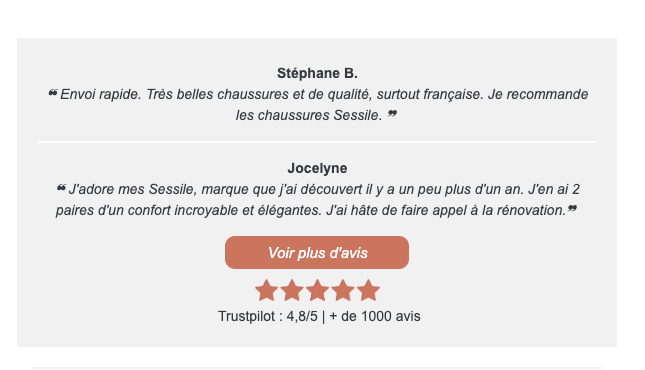
Ask yourself these questions:
- How many customers do you have for the product or service you're promoting?
- Do you have a rating (trustpilot or other)?
- Do you have any testimonials to share?
Aligning values with purchasing actions
In neuropsychology and marketing, the alignment between an individual's personal values and the consumption of a product/service is a powerful trigger for action.
When a product or service resonates with our deepest values, our brain activates the reward system. This activation generates a feeling of coherence.
Buying in line with our values stimulates the production of dopamine, positively reinforcing buying behavior and creating a lasting mental association between the product and our personal identity.
In marketing, exploiting this alignment of values allows you to :
- Creating a sense of belonging Buying becomes an act of identity affirmation («I'm the type of person who...»)
- Reduce price sensitivity Consumers are willing to pay more for products that embody their values
- Facilitating the transition to action : Aligning values removes the rational and emotional brakes that delay purchase
To activate this psychological lever in your email campaigns, ask yourself these questions:
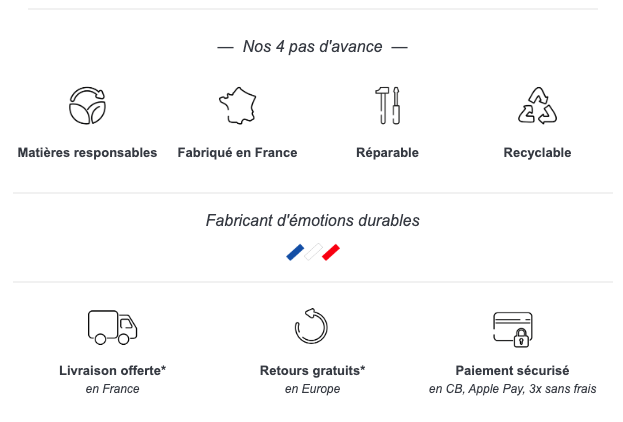
- What are your brand values (ecology, innovation, tradition, performance, etc.)?
- What concrete proof is there?
- What makes your brand reassuring? Why should your target trust you to perform the requested action?
- Formulate your messages by highlighting how your product/service embodies these values
For example, instead of «Buy our ecological product», say «Join our 5,000 customers who choose to protect» - this wording transforms the purchase into a statement of identity.
Step 4. Respecting local laws: contextualizing
To capture your readers' interest, put yourself in their shoes and speak their language. Proximity can mean understanding and sharing their problems.It can be about the company's concerns, issues or challenges, particularly in B2B. It can also be geographical, emotional or cultural.
Put yourself in your reader's shoes and ask yourself :
- What are its concerns and challenges?
- What are the stakes and challenges?
- What are the highlights of his life?
- How can my message help him overcome his difficulties or achieve his goals?
In short, if you were in his shoes, what would you like to receive?
In-depth knowledge of your target audience is essential to answer these questions effectively.
Step 5. Write with your key message in the subject line
The main message must appear in the subject line and your email preheader. As readers, we want to know immediately if the subject of the email concerns us, interests us or is important to us. At a glance, we need to decide whether the email is worth opening.
- The sender's label It must be known to your readers and must not change. It's usually the company name.
- The object :
- It must reflect the essential message to be conveyed, with the right angle of attack.
- It must be faithful to the content's promise: newsletter, invitation, sale, etc.
- It should not be a secondary subject of the email.
- It should be short (around 6 to 10 words) and ideally fully readable on mobile. If this is not possible, place the most important words at the beginning of the object.
- There's no need to include the sender's name in the subject line - it's a waste of space.
- The preheader must provide additional information to the object, adding an additional argument.
Test the smartphone rendering of your label/object/preheader with this handy free tool: Email Subject Lines Tester.
Step 6. Prioritize your messages with visual cues in your email
Once the email has been opened, you only have a few seconds to convince the reader to read your newsletter and interact with its content.
An email is not read word for word; it is first scanned diagonally..
Only if the reader finds elements of interest in a quick scan of the content will he or she take the time to read it in detail.
Place your messages in visual landmarks
To facilitate this diagonal reading and guarantee optimal comprehension, position your key messages in visual elements such as :
- Headings, subheadings, CTAs (Call to Action), labels or categories
- Highlight blocks, borders, strokes, background colors, bold words, separators
These elements must be carefully highlighted to direct and hold the reader's attention, even when reading quickly.
The main title
The main title is often a repetition of the object, which is a mistake. The object has just been read and is still fresh in the reader's mind. Instead, the main title should reinforce interest in the object and preheaderby adding value. The subject line, preheader and main title must flow logically without redundancy.
The brain values what brings an immediate victory Show the first step in the main title, show the micro-victory that triggers the action. Create emotion. Without emotion, there can be no decision.
For example, instead of writing a descriptive text such as: “The Minute Cutter is free with the purchase of a Thermomix“, you could write: "The Minute Cutter is free with the purchase of a Thermomix".“
Write a subject line or a title that helps your target audience to think ahead: «Become a home chef: the perfect duo for smart cooking” or “Transform your daily culinary routine” , “Save 1 hour a day in the kitchen”, “The duo that revolutionizes 14 meals a week”...
Please note: «Zoom in» or «Editorial» or «Newsletter» should not be your main headline, but rather a designer heading (label or category). Instead, your main title should be a key message for your readers to remember.
Editorial tips
The brain loves precision.
- Instead of writing «Offer valid until 04/12/2025», write «Ends in 4 days».»
- Instead of saying «We help you find more customers», write «We bring you 10 qualified appointments per month.»
- Instead of saying, «Gain productivity,» write, «Gain 1 hour a day with these 3 steps.»
- «Tips for the end of the year‘ becomes »5 tips for the end of the year«.»
Our brain prefers saving energy and avoid complex information. Simplify messages and use bullet points to maximize diagonal reading.
Loss aversion: We feel the pain of losing something more strongly than the pleasure of gaining it.
With this in mind:
- «Enjoy» becomes «Don't miss».»
- “-10% reduction” > «Save €100»
Call to Action (CTA)
The CTA must attract without intimidating, naturally following the reader's path.
- The verb used must relate to the action requested. Examples: "Je prends rendez-vous" ("I make an appointment"), "Je télécharge" ("I download"), or related to the company's lexical field: "Je chine engagé" ("I hunt with commitment"), "J'achète solidaire" ("I buy with solidarity") (second-hand sector), "Je feuillette" ("I leaf through") (publishing sector).
- Avoid passive, non-explicit formulas such as «Learn more», «Read more», «Click here», «I take advantage», «I discover». Even if the last two can be difficult to avoid, try as hard as you can.
Step 7. Read your email as if you were one of your readers
To check the effectiveness of your structuring, send yourself a proof copy and put yourself in your reader's shoes:
- On your smartphone, start by reading the sender label, subject line and preheader. Assess whether they are sufficiently attention-grabbing by putting yourself in your reader's shoes (with their mental load, their concerns, their challenges).
- Then open the email without loading images, and read only the visual cues: headings, subheadings, CTAs, highlighted blocks. Make sure that the messages you want to get across are clear and understandable in a quick diagonal read.
- Load the images and check that they reinforce the message without altering understanding.
- Finally, read the entire email aloud: if it reads smoothly and you don't stumble over words, your email is well written.
Putting it into practice: examples of before-and-after email copywriting
Example of how to write a product email
Move your mouse over the original email visual to see the revised email.
- Campaign objectives / Why are you sending this email?
- to present the Equateur radiator.
- to talk about a current promotional offer: purchase of 3 radiators, -150 €.
- What's so special about this product?
- It is gentle heat.
- Energy savings thanks to intelligent control and detection systems.
- Comfort: does not dry out the air like conventional electric radiators.
- Design: sober and elegant.
- What questions might readers have at this stage?
- What is a soft-heat radiator? What's so special about them?
- Is it easy to install on your own?
- Can I call someone to ask my specific questions?
- What information should you provide that is in line with Thermor's values and raison d'être?
- Programming tips to limit energy losses
- Show that it can be repaired
- 2-year warranty
- French brand
Example of before/after wording for an email offer
- Campaign objectives :
- present the insurance offer
- obtain lead requests
- What's different about the product?
- an offer adapted to all income levels
- with one of the lowest deductibles on the market
- What questions might readers have at this stage?
- am i well covered?
- how much will it cost me?
- can I call someone to ask my questions?
- What information should you provide that is in line with your company's values and raison d'être?
- we're fighting against underinsurance, for the protection of purchasing power and for access to housing for all.
Example of before/after wording for a welcome email
Example of before/after copywriting for a cart abandonment email
Basic good writing practices
Each organization should establish its own rules for writing, its own writing framework. Nevertheless, here are a few good writing practices to follow:
Keep it simple
You don't need any special talent to be a good writer. The main objective is to be understood. So write simply.
- Use short sentences: subject, verb, complement.
- Avoid jargon that requires explanation (unless you're dealing with experts).
- Limit the excessive use of adjectives: too many adjectives detract from the credibility of the message.
- 1 paragraph = 1 idea.
- Pace your writing with punctuation to energize reading. For example: "Tired of those sore muscles? Try heat compresses.
- Limit the overuse of "-ment" adverbs. Excessive use also undermines credibility.
Be precise
Precise information is more likely to be retained by the reader. Use numbers and bulleted lists. Avoid excessive "..." and "etc.", which can give an impression of vagueness and clutter.
Be explicit
Your email can be read by voice assistants for the visually impaired. Forget links behind non-explicit words or groups of words such as «follow this link», «click here», «find out more», «here», etc.»
They are very often found in headers and footers.
Avoid writing text in your visuals
A significant proportion of your target audience (and even more so in B2B) read their emails via messaging systems that don't display images by default.
A non-negligible proportion of your audience are undoubtedly disabled and need technical or voice assistance to read their emails.
For these two reasons, don't include text in your visuals. And don't tell yourself it's enough to put alternative text behind the image. Not all messaging systems display alternative text, and when they do, it's in a font size of around 12 px, which isn't very readable.
Write alternative texts only if necessary!
There's a widespread belief in email marketing: you should fill the alternative texts with all the visuals. This exhausts everyone and you end up with alternative texts such as «Image 01», «Image 02», «Image article»... with no added value for the reader.
Let's be clear: the alt attribute must be present on all visuals, but it doesn't have to be filled in!
Fill in your alternative texts only on useful images. On decorative images, leave them empty.
Read this article to learn how to distinguish between decorative and useful images.
Read aloud
Reread the subject, preheader and content of your email aloud. If you stumble over certain words or if it doesn't read smoothly, rewrite the text.
Checklist of best practices in emailing copywriting
Here's a checklist summarizing the points discussed above. Don't hesitate to use it as inspiration before validating your emails.
| Your sender label is known and identifiable by your target. | X |
| Your subject line speaks to the main message of your email. | |
| Keep your subject line short and place the most important words at the beginning. | |
| Your preheader provides additional information about the object. | |
| Does the subject/preheader combination arouse interest and make people want to open the email? | |
| The main title confirms the interest of the object and the preheader, and does not repeat either the object or the preheader. | |
| In your text, you answered the question: How does my reader relate to my message? | |
| You put yourself in his shoes and talk about his world (challenges / difficulties). | |
| The main CTA is positioned as high as possible in the email. It should be clear and engaging. | |
| The verbs used in the CTAs are related to the lexical field. | |
| You've used simple, short sentences with a single verb (few subordinate clauses with who, what, which, where, because...). | |
| You've bolded a few words. No full sentences in bold. | |
| You haven't overused adjectives. | |
| You've used the active form. | |
| You've limited the use of adverbs (all -ement words such as concretely, sincerely, truly...) (1 or 2 max allowed). | |
| You've chosen 2 conjugated verbs in a row rather than the gerund. | |
| You've explained all the technical terms (acronyms, jargon, etc.). | |
| You've added titles, subtitles, borders, background colors and a few bold words to make it easier to find. | |
| You read the email aloud to see if the sentences are clear. | |
| You've checked and double-checked the spelling. |
Conclusion
To write a powerful email, you need to have in mind the key messages you want to convey to your targets, choose the right angle of attack, structure your messages clearly and highlight them with visual cues. By applying these principles, you'll capture attention from the very first seconds and maximize the impact of your communications.
